The Financial World
Travel for Medical Treatment: What India’s Second Largest Travel Purpose Reveals
Dr. P. S. Vohra
Author & Economic Thinker
India’s tourism landscape is changing, but one of the most significant changes is not about where Indians are travelling for leisure. It is about why they are travelling at all. Indians are increasingly travelling not only for holidays, recreation or pilgrimage, but for something far more compelling: medical treatment. According to the Ministry of Statistics and Programme Implementation’s Domestic Tourism Expenditure Survey covering July 2025 to June 2026, 29.6 percent of domestic travel was related to health and medical purposes. Religious and pilgrimage travel accounted for 47.7 percent, while holidays, recreation and leisure accounted for 22.1 percent. Medical travel has therefore emerged as the second-largest purpose of domestic travel. This is not merely a tourism statistic; it is also a reflection of how healthcare is distributed across the country.
India’s tourism economy is already substantial. In 2025, Indians spent approximately 17.7 lakh crore rupees on travel and tourism within the country, accounting for nearly 86 percent of the country’s total annual travel and tourism expenditure. This expenditure grew by around 10 percent during the year. These figures establish that India’s tourism economy is driven overwhelmingly by its own population. But the growing share of medical travel requires us to look beyond tourism. Travelling to another city because one wants to see it is tourism. Travelling because treatment is unavailable at home is a healthcare issue. It raises a basic question: Why are so many Indians having to leave their own towns and cities to receive medical treatment?
The financial burden of such travel is also significant.
According to the survey, the average expenditure on health and medical travel was around 29,454 rupees in rural areas and 41,649 rupees in urban areas. In rural households, nearly 75 percent of health-related travel expenditure went towards treatment and medicines, while government reimbursement accounted for only about 8.2 percent. But the actual cost is much larger. Families also pay for transportation, accommodation and food, while a patient is often accompanied by a family member who may lose several days of income. For those requiring repeated consultations or prolonged treatment, the financial burden can become substantial. The rural picture is particularly revealing. Among overnight domestic trips, health and medical travel accounted for 38.4 percent in rural areas, compared with 16.5 percent in urban areas. This suggests that medical travel is not simply an urban phenomenon; for many rural families, travelling for treatment is becoming part of the healthcare experience itself.
The concentration of patients in certain states and cities provides another important clue. Uttar Pradesh, Bihar and West Bengal together account for more than 30 percent of health and medical travel. Their large populations are undoubtedly one reason, but population alone cannot explain the pattern. In many parts of these states, specialised and advanced medical facilities have not expanded sufficiently in proportion to population and healthcare requirements. Patients requiring cancer treatment, advanced cardiac care, IVF, joint replacement or other specialised procedures therefore travel to other cities and states. This is a long-standing regional challenge in health planning. Delhi is a clear example. Institutions such as AIIMS receive patients from across the country because they offer specialised treatment at comparatively low cost under the public healthcare system. This reflects the capability and public trust enjoyed by these institutions, but it also exposes a structural problem: high-end public healthcare remains concentrated in a limited number of cities. Treatment may be relatively affordable after reaching such a centre, but the journey, accommodation and repeated visits can impose a heavy burden on poor and lower-middle-income families.
At the same time, India has developed major private healthcare centres that attract patients from across the country. Gujarat, for example, has built considerable expertise in cardiac care, cancer treatment, orthopaedics, joint replacement, infertility treatment and IVF. Around these hospitals, an entire economic ecosystem involving diagnostics, medicines, hotels and transportation has developed, contributing to regional economic growth. Kerala has created a different model by combining modern medicine with Ayurveda, rehabilitation, wellness and healthcare services. Chennai, Hyderabad, Mumbai and Bengaluru have also emerged as major centres for complex medical treatment. These developments demonstrate India’s growing medical capabilities, but they also underline the geographic concentration of specialised healthcare.
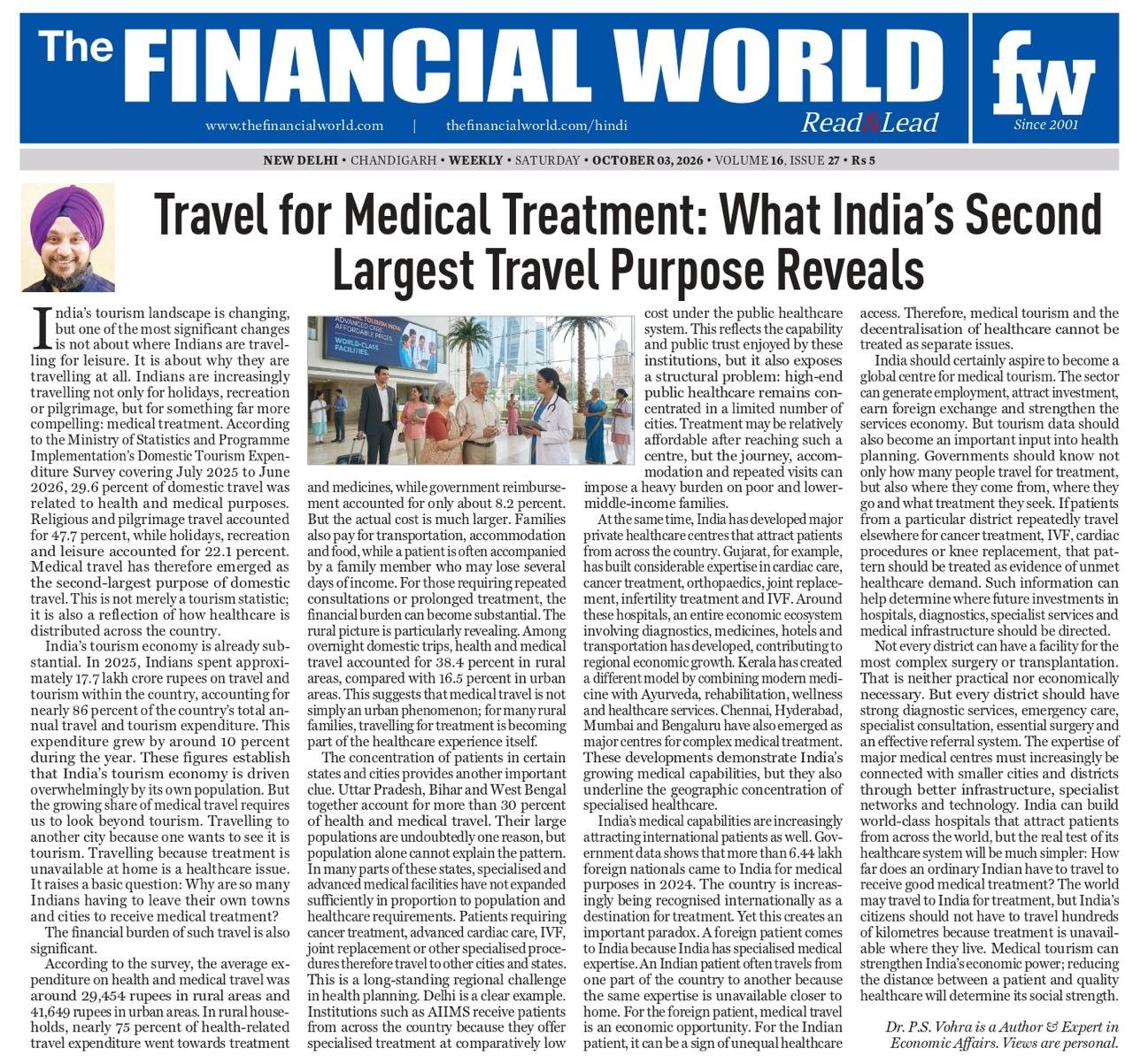
India’s medical capabilities are increasingly attracting international patients as well. Government data shows that more than 6.44 lakh foreign nationals came to India for medical purposes in 2024. The country is increasingly being recognised internationally as a destination for treatment. Yet this creates an important paradox. A foreign patient comes to India because India has specialised medical expertise. An Indian patient often travels from one part of the country to another because the same expertise is unavailable closer to home. For the foreign patient, medical travel is an economic opportunity. For the Indian patient, it can be a sign of unequal healthcare access. Therefore, medical tourism and the decentralisation of healthcare cannot be treated as separate issues.
India should certainly aspire to become a global centre for medical tourism. The sector can generate employment, attract investment, earn foreign exchange and strengthen the services economy. But tourism data should also become an important input into health planning. Governments should know not only how many people travel for treatment, but also where they come from, where they go and what treatment they seek. If patients from a particular district repeatedly travel elsewhere for cancer treatment, IVF, cardiac procedures or knee replacement, that pattern should be treated as evidence of unmet healthcare demand. Such information can help determine where future investments in hospitals, diagnostics, specialist services and medical infrastructure should be directed.
Not every district can have a facility for the most complex surgery or transplantation. That is neither practical nor economically necessary. But every district should have strong diagnostic services, emergency care, specialist consultation, essential surgery and an effective referral system. The expertise of major medical centres must increasingly be connected with smaller cities and districts through better infrastructure, specialist networks and technology. India can build world-class hospitals that attract patients from across the world, but the real test of its healthcare system will be much simpler: How far does an ordinary Indian have to travel to receive good medical treatment? The world may travel to India for treatment, but India’s citizens should not have to travel hundreds of kilometres because treatment is unavailable where they live. Medical tourism can strengthen India’s economic power; reducing the distance between a patient and quality healthcare will determine its social strength.