The Financial World
Cash Transfers to Women: Economic Empowerment with a Fiscal Challenge
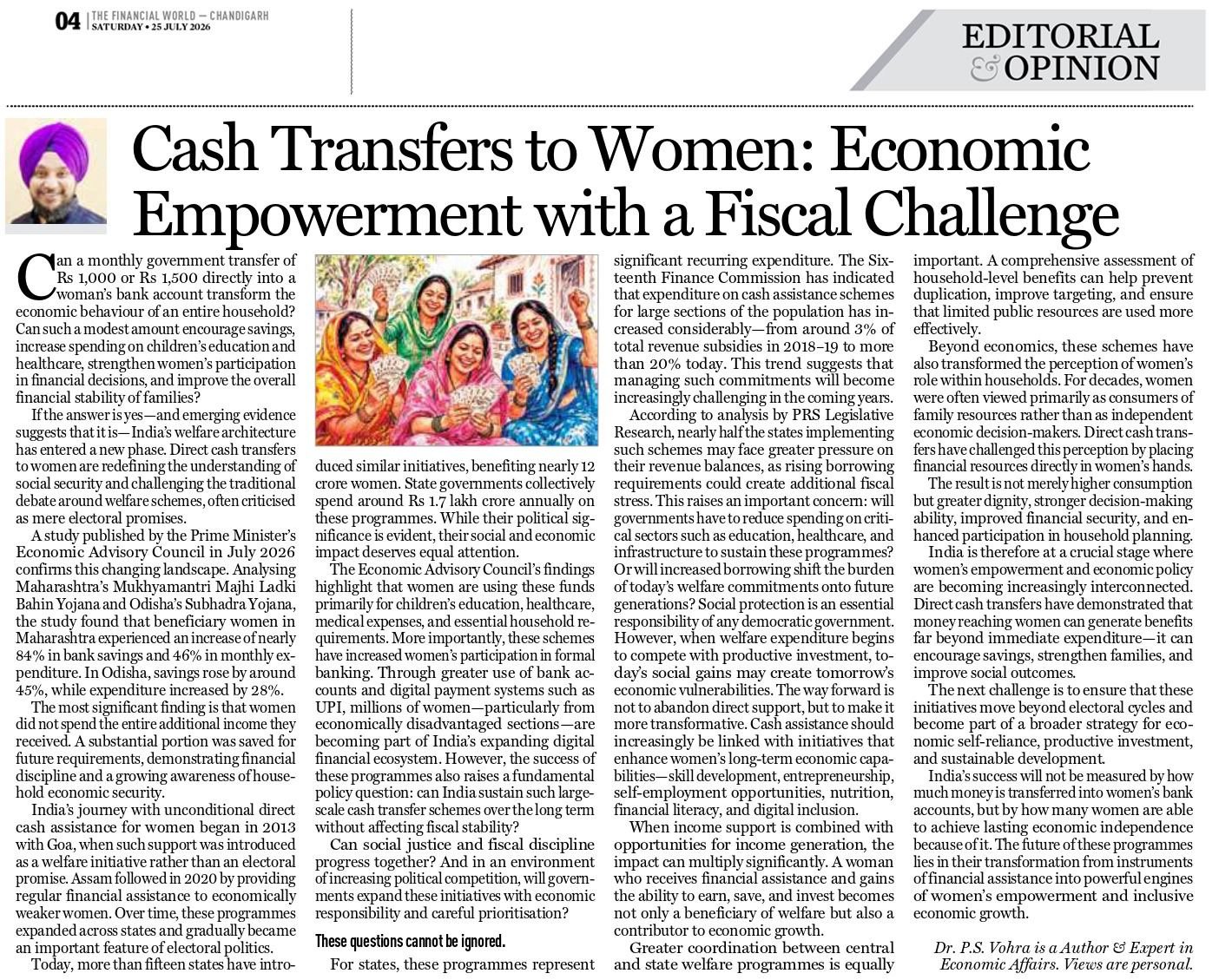
Can a monthly government transfer of Rs 1,000 or Rs 1,500 directly into a woman's bank account transform the economic behaviour of an entire household? Can such a modest amount encourage savings, increase spending on children's education and healthcare, strengthen women's participation in financial decisions, and improve the overall financial stability of families?
If the answer is yes—and emerging evidence suggests that it is—India's welfare architecture has entered a new phase. Direct cash transfers to women are redefining the understanding of social security and challenging the traditional debate around welfare schemes, often criticised as mere electoral promises.
A study published by the Prime Minister's Economic Advisory Council in July 2026 confirms this changing landscape. Analysing Maharashtra's Mukhyamantri Majhi Ladki Bahin Yojana and Odisha's Subhadra Yojana, the study found that beneficiary women in Maharashtra experienced an increase of nearly 84% in bank savings and 46% in monthly expenditure. In Odisha, savings rose by around 45%, while expenditure increased by 28%.
The most significant finding is that women did not spend the entire additional income they received. A substantial portion was saved for future requirements, demonstrating financial discipline and a growing awareness of household economic security.
India's journey with unconditional direct cash assistance for women began in 2013 with Goa, when such support was introduced as a welfare initiative rather than an electoral promise. Assam followed in 2020 by providing regular financial assistance to economically weaker women. Over time, these programmes expanded across states and gradually became an important feature of electoral politics.
Today, more than fifteen states have introduced similar initiatives, benefiting nearly 12 crore women. State governments collectively spend around Rs 1.7 lakh crore annually on these programmes. While their political significance is evident, their social and economic impact deserves equal attention.
The Economic Advisory Council's findings highlight that women are using these funds primarily for children's education, healthcare, medical expenses, and essential household requirements. More importantly, these schemes have increased women's participation in formal banking. Through greater use of bank accounts and digital payment systems such as UPI, millions of women—particularly from economically disadvantaged sections—are becoming part of India's expanding digital financial ecosystem. However, the success of these programmes also raises a fundamental policy question: can India sustain such large-scale cash transfer schemes over the long term without affecting fiscal stability?
Can social justice and fiscal discipline progress together? And in an environment of increasing political competition, will governments expand these initiatives with economic responsibility and careful prioritisation?
These questions cannot be ignored.
For states, these programmes represent significant recurring expenditure. The Sixteenth Finance Commission has indicated that expenditure on cash assistance schemes for large sections of the population has increased considerably—from around 3% of total revenue subsidies in 2018–19 to more than 20% today. This trend suggests that managing such commitments will become increasingly challenging in the coming years.
According to analysis by PRS Legislative Research, nearly half the states implementing such schemes may face greater pressure on their revenue balances, as rising borrowing requirements could create additional fiscal stress. This raises an important concern: will governments have to reduce spending on critical sectors such as education, healthcare, and infrastructure to sustain these programmes? Or will increased borrowing shift the burden of today's welfare commitments onto future generations? Social protection is an essential responsibility of any democratic government. However, when welfare expenditure begins to compete with productive investment, today's social gains may create tomorrow's economic vulnerabilities. The way forward is not to abandon direct support, but to make it more transformative. Cash assistance should increasingly be linked with initiatives that enhance women's long-term economic capabilities—skill development, entrepreneurship, self-employment opportunities, nutrition, financial literacy, and digital inclusion.
When income support is combined with opportunities for income generation, the impact can multiply significantly. A woman who receives financial assistance and gains the ability to earn, save, and invest becomes not only a beneficiary of welfare but also a contributor to economic growth.
Greater coordination between central and state welfare programmes is equally important. A comprehensive assessment of household-level benefits can help prevent duplication, improve targeting, and ensure that limited public resources are used more effectively.
Beyond economics, these schemes have also transformed the perception of women's role within households. For decades, women were often viewed primarily as consumers of family resources rather than as independent economic decision-makers. Direct cash transfers have challenged this perception by placing financial resources directly in women's hands.
The result is not merely higher consumption but greater dignity, stronger decision-making ability, improved financial security, and enhanced participation in household planning.
India is therefore at a crucial stage where women's empowerment and economic policy are becoming increasingly interconnected. Direct cash transfers have demonstrated that money reaching women can generate benefits far beyond immediate expenditure—it can encourage savings, strengthen families, and improve social outcomes.
The next challenge is to ensure that these initiatives move beyond electoral cycles and become part of a broader strategy for economic self-reliance, productive investment, and sustainable development.
India's success will not be measured by how much money is transferred into women's bank accounts, but by how many women are able to achieve lasting economic independence because of it. The future of these programmes lies in their transformation from instruments of financial assistance into powerful engines of women's empowerment and inclusive economic growth.
*Dr. P.S. Vohra is a Author & Expert in Economic Affairs. Views are personal.*