The Financial World
Will India’s Farmers Pay the Price for Trump’s $500 Billion Trade Ambition?
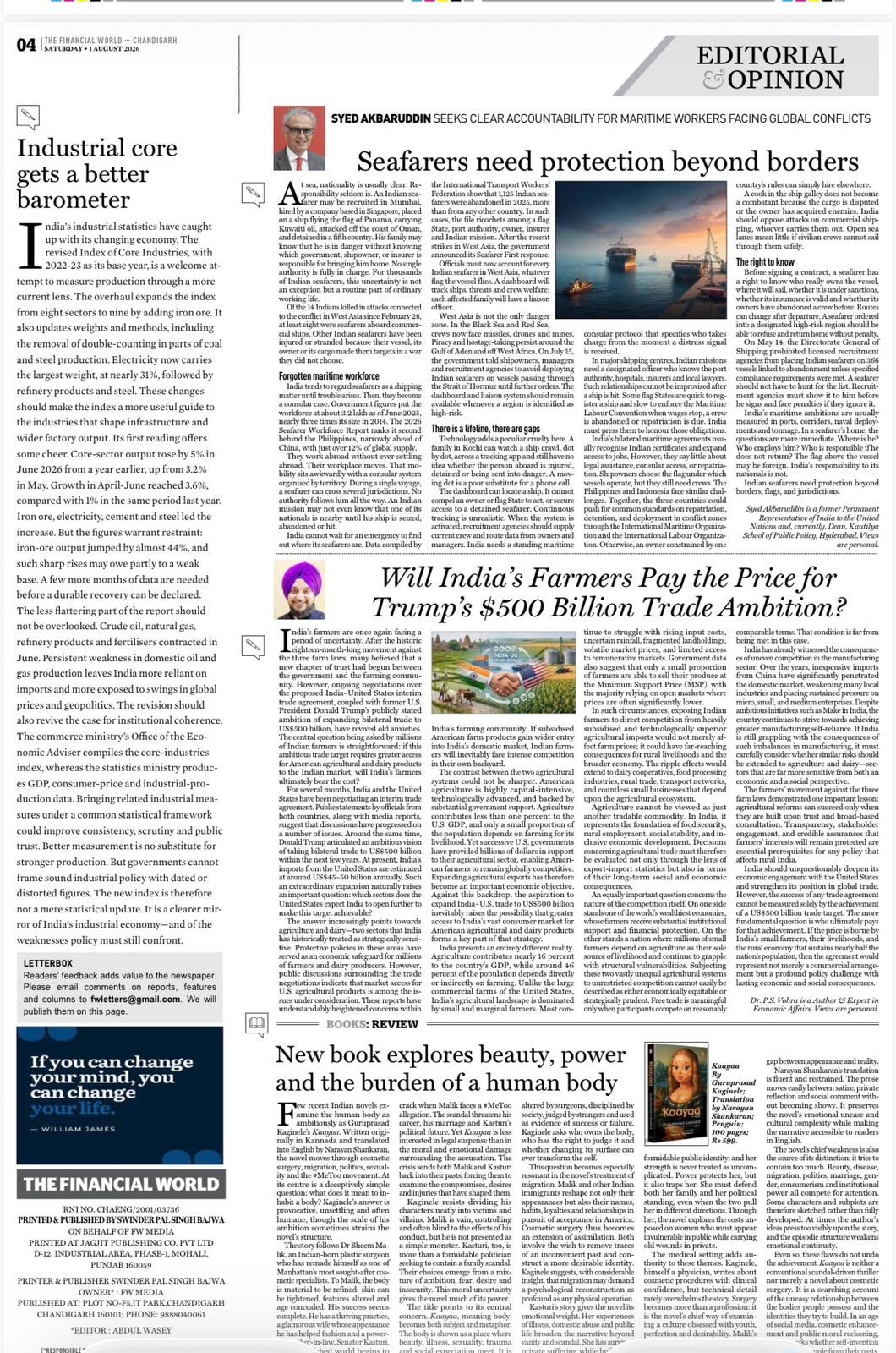
India's farmers are once again facing a period of uncertainty. After the historic eighteen-month-long movement against the three farm laws, many believed that a new chapter of trust had begun between the government and the farming community. However, ongoing negotiations over the proposed India–United States interim trade agreement, coupled with former U.S. President Donald Trump's publicly stated ambition of expanding bilateral trade to US$500 billion, have revived old anxieties. The central question being asked by millions of Indian farmers is straightforward: if this ambitious trade target requires greater access for American agricultural and dairy products to the Indian market, will India's farmers ultimately bear the cost?
For several months, India and the United States have been negotiating an interim trade agreement. Public statements by officials from both countries, along with media reports, suggest that discussions have progressed on a number of issues. Around the same time, Donald Trump articulated an ambitious vision of taking bilateral trade to US$500 billion within the next few years. At present, India's imports from the United States are estimated at around US$45–50 billion annually. Such an extraordinary expansion naturally raises an important question: which sectors does the United States expect India to open further to make this target achievable?
The answer increasingly points towards agriculture and dairy—two sectors that India has historically treated as strategically sensitive. Protective policies in these areas have served as an economic safeguard for millions of farmers and dairy producers. However, public discussions surrounding the trade negotiations indicate that market access for U.S. agricultural products is among the issues under consideration. These reports have understandably heightened concerns within India's farming community. If subsidised American farm products gain wider entry into India's domestic market, Indian farmers will inevitably face intense competition in their own backyard.
The contrast between the two agricultural systems could not be sharper. American agriculture is highly capital-intensive, technologically advanced, and backed by substantial government support. Agriculture contributes less than one percent to the U.S. GDP, and only a small proportion of the population depends on farming for its livelihood. Yet successive U.S. governments have provided billions of dollars in support to their agricultural sector, enabling American farmers to remain globally competitive. Expanding agricultural exports has therefore become an important economic objective. Against this backdrop, the aspiration to expand India–U.S. trade to US$500 billion inevitably raises the possibility that greater access to India's vast consumer market for American agricultural and dairy products forms a key part of that strategy.
India's own reality is entirely different. Agriculture contributes nearly 16 percent to the country's GDP, while around 46 percent of the population depends directly or indirectly on farming. Unlike the large commercial farms of the United States, India's agricultural landscape is dominated by small and marginal farmers. Most continue to struggle with rising input costs, uncertain rainfall, fragmented landholdings, volatile market prices, and limited access to remunerative markets. Government data also suggest that only a small proportion of farmers are able to sell their produce at the Minimum Support Price (MSP), with the majority relying on open markets where prices are often significantly lower.
In such circumstances, exposing Indian farmers to direct competition from heavily subsidised and technologically superior agricultural imports would not merely affect farm prices; it could have far-reaching consequences for rural livelihoods and the broader economy. The ripple effects would extend to dairy cooperatives, food processing industries, rural trade, transport networks, and countless small businesses that depend upon the agricultural ecosystem.
Agriculture cannot be viewed as just another tradable commodity. In India, it represents the foundation of food security, rural employment, social stability, and inclusive economic development. Decisions concerning agricultural trade must therefore be evaluated not only through the lens of export-import statistics but also in terms of their long-term social and economic consequences.
An equally important question concerns the nature of the competition itself. On one side stands one of the world's wealthiest economies, whose farmers receive substantial institutional support and financial protection. On the other stands a nation where millions of small farmers depend on agriculture as their sole source of livelihood and continue to grapple with structural vulnerabilities. Subjecting these two vastly unequal agricultural systems to unrestricted competition cannot easily be described as either economically equitable or strategically prudent. Free trade is meaningful only when participants compete on reasonably comparable terms. That condition is far from being met in this case.
India has already witnessed the consequences of uneven competition in the manufacturing sector. Over the years, inexpensive imports from China have significantly penetrated the domestic market, weakening many local industries and placing sustained pressure on micro, small, and medium enterprises. Despite ambitious initiatives such as Make in India, the country continues to strive towards achieving greater manufacturing self-reliance. If India is still grappling with the consequences of such imbalances in manufacturing, it must carefully consider whether similar risks should be extended to agriculture and dairy—sectors that are far more sensitive from both an economic and a social perspective.
The farmers' movement against the three farm laws demonstrated one important lesson: agricultural reforms can succeed only when they are built upon trust and broad-based consultation. Transparency, stakeholder engagement, and credible assurances that farmers' interests will remain protected are essential prerequisites for any policy that affects rural India.
India should unquestionably deepen its economic engagement with the United States and strengthen its position in global trade. However, the success of any trade agreement cannot be measured solely by the achievement of a US$500 billion trade target. The more fundamental question is who ultimately pays for that achievement. If the price is borne by India's small farmers, their livelihoods, and the rural economy that sustains nearly half the nation's population, then the agreement would represent not merely a commercial arrangement but a profound policy challenge with lasting economic and social consequences.
*Dr. P.S. Vohra is a Author & Expert in Economic Affairs. Views are personal.*