First India
UPI’s Next Revolution: The Bank May Come to the Merchant
Dr. P. S. Vohra
Author & Senior Economic Affairs Expert
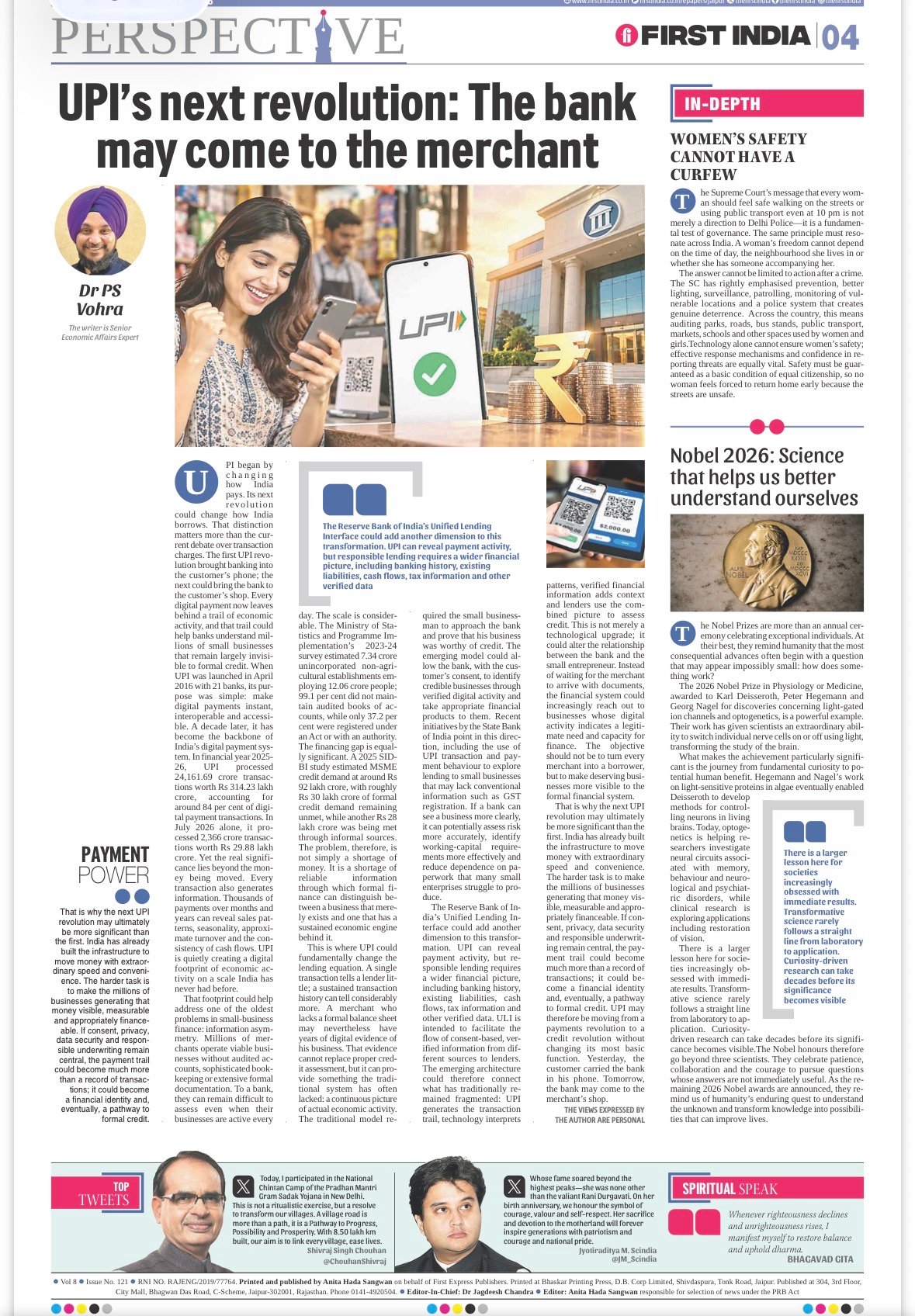
UPI began by changing how India pays. Its next revolution could change how India borrows. That distinction matters more than the current debate over transaction charges. The first UPI revolution brought banking into the customer’s phone; the next could bring the bank to the customer’s shop. Every digital payment now leaves behind a trail of economic activity, and that trail could help banks understand millions of small businesses that remain largely invisible to formal credit. When UPI was launched in April 2016 with 21 banks, its purpose was simple: make digital payments instant, interoperable and accessible. A decade later, it has become the backbone of India’s digital payment system. In financial year 2025-26, UPI processed 24,161.69 crore transactions worth Rs 314.23 lakh crore, accounting for around 84 per cent of digital payment transactions. In July 2026 alone, it processed 2,366 crore transactions worth Rs 29.88 lakh crore. Yet the real significance lies beyond the money being moved. Every transaction also generates information. Thousands of payments over months and years can reveal sales patterns, seasonality, approximate turnover and the consistency of cash flows.
UPI is quietly creating a digital footprint of economic activity on a scale India has never had before.That footprint could help address one of the oldest problems in small-business finance: information asymmetry. Millions of merchants operate viable businesses without audited accounts, sophisticated bookkeeping or extensive formal documentation. To a bank, they can remain difficult to assess even when their businesses are active every day. The scale is considerable. The Ministry of Statistics and Programme Implementation’s 2023-24 survey estimated 7.34 crore unincorporated non-agricultural establishments employing 12.06 crore people; 99.1 per cent did not maintain audited books of accounts, while only 37.2 per cent were registered under an Act or with an authority. The financing gap is equally significant. A 2025 SIDBI study estimated MSME credit demand at around Rs 92 lakh crore, with roughly Rs 30 lakh crore of formal credit demand remaining unmet, while another Rs 28 lakh crore was being met through informal sources. The problem, therefore, is not simply a shortage of money. It is a shortage of reliable information through which formal finance can distinguish between a business that merely exists and one that has a sustained economic engine behind it.
This is where UPI could fundamentally change the lending equation. A single transaction tells a lender little; a sustained transaction history can tell considerably more. A merchant who lacks a formal balance sheet may nevertheless have years of digital evidence of his business. That evidence cannot replace proper credit assessment, but it can provide something the traditional system has often lacked: a continuous picture of actual economic activity. The traditional model required the small businessman to approach the bank and prove that his business was worthy of credit. The emerging model could allow the bank, with the customer’s consent, to identify credible businesses through verified digital activity and take appropriate financial products to them. Recent initiatives by the State Bank of India point in this direction, including the use of UPI transaction and payment behaviour to explore lending to small businesses that may lack conventional information such as GST registration. If a bank can see a business more clearly, it can potentially assess risk more accurately, identify working-capital requirements more effectively and reduce dependence on paperwork that many small enterprises struggle to produce.The Reserve Bank of India’s Unified Lending Interface could add another dimension to this transformation. UPI can reveal payment activity, but responsible lending requires a wider financial picture, including banking history, existing liabilities, cash flows, tax information and other verified data. ULI is intended to facilitate the flow of consent-based, verified information from different sources to lenders. The emerging architecture could therefore connect what has traditionally remained fragmented: UPI generates the transaction trail, technology interprets patterns, verified financial information adds context and lenders use the combined picture to assess credit. This is not merely a technological upgrade; it could alter the relationship between the bank and the small entrepreneur. Instead of waiting for the merchant to arrive with documents, the financial system could increasingly reach out to businesses whose digital activity indicates a legitimate need and capacity for finance.
The objective should not be to turn every merchant into a borrower, but to make deserving businesses more visible to the formal financial system.That is why the next UPI revolution may ultimately be more significant than the first. India has already built the infrastructure to move money with extraordinary speed and convenience. The harder task is to make the millions of businesses generating that money visible, measurable and appropriately financeable. If consent, privacy, data security and responsible underwriting remain central, the payment trail could become much more than a record of transactions; it could become a financial identity and, eventually, a pathway to formal credit. UPI may therefore be moving from a payments revolution to a credit revolution without changing its most basic function. Yesterday, the customer carried the bank in his phone. Tomorrow, the bank may come to the merchant’s shop.