The Financial World
Economics Nobel 2026: Its Relevance and Policy Challenges for India.
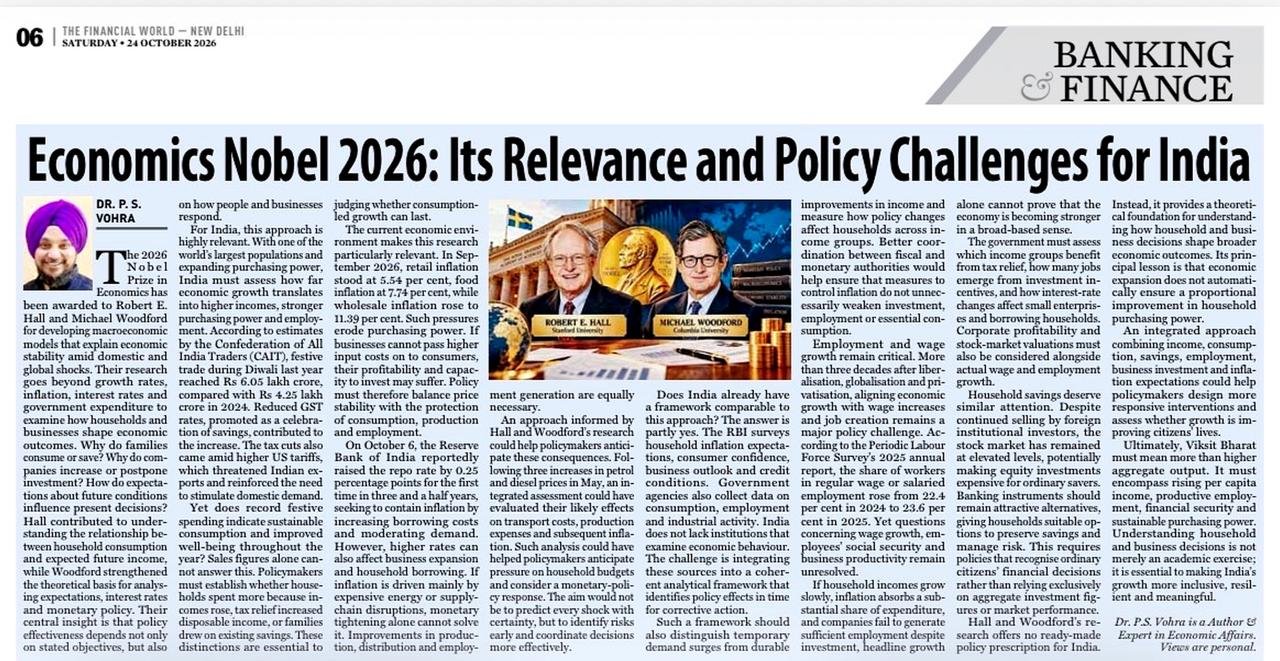
The 2026 Nobel Prize in Economics has been awarded to Robert E. Hall and Michael Woodford for developing macroeconomic models that explain economic stability amid domestic and global shocks. Their research goes beyond growth rates, inflation, interest rates and government expenditure to examine how households and businesses shape economic outcomes. Why do families consume or save? Why do companies increase or postpone investment? How do expectations about future conditions influence present decisions? Hall contributed to understanding the relationship between household consumption and expected future income, while Woodford strengthened the theoretical basis for analysing expectations, interest rates and monetary policy. Their central insight is that policy effectiveness depends not only on stated objectives, but also on how people and businesses respond.
For India, this approach is highly relevant. With one of the world’s largest populations and expanding purchasing power, India must assess how far economic growth translates into higher incomes, stronger purchasing power and employment. According to estimates by the Confederation of All India Traders (CAIT), festive trade during Diwali last year reached Rs 6.05 lakh crore, compared with Rs 4.25 lakh crore in 2024. Reduced GST rates, promoted as a celebration of savings, contributed to the increase. The tax cuts also came amid higher US tariffs, which threatened Indian exports and reinforced the need to stimulate domestic demand.
Yet does record festive spending indicate sustainable consumption and improved well-being throughout the year? Sales figures alone cannot answer this. Policymakers must establish whether households spent more because incomes rose, tax relief increased disposable income, or families drew on existing savings. These distinctions are essential to judging whether consumption-led growth can last.
The current economic environment makes this research particularly relevant. In September 2026, retail inflation stood at 5.54 per cent, food inflation at 7.74 per cent, while wholesale inflation rose to 11.39 per cent. Such pressures erode purchasing power. If businesses cannot pass higher input costs on to consumers, their profitability and capacity to invest may suffer. Policy must therefore balance price stability with the protection of consumption, production and employment.
On October 6, the Reserve Bank of India reportedly raised the repo rate by 0.25 percentage points for the first time in three and a half years, seeking to contain inflation by increasing borrowing costs and moderating demand. However, higher rates can also affect business expansion and household borrowing. If inflation is driven mainly by expensive energy or supply-chain disruptions, monetary tightening alone cannot solve it. Improvements in production, distribution and employment generation are equally necessary.
An approach informed by Hall and Woodford’s research could help policymakers anticipate these consequences. Following three increases in petrol and diesel prices in May, an integrated assessment could have evaluated their likely effects on transport costs, production expenses and subsequent inflation. Such analysis could have helped policymakers anticipate pressure on household budgets and consider a monetary-policy response. The aim would not be to predict every shock with certainty, but to identify risks early and coordinate decisions more effectively.
Does India already have a framework comparable to this approach? The answer is partly yes. The RBI surveys household inflation expectations, consumer confidence, business outlook and credit conditions. Government agencies also collect data on consumption, employment and industrial activity. India does not lack institutions that examine economic behaviour. The challenge is integrating these sources into a coherent analytical framework that identifies policy effects in time for corrective action.
Such a framework should also distinguish temporary demand surges from durable improvements in income and measure how policy changes affect households across income groups. Better coordination between fiscal and monetary authorities would help ensure that measures to control inflation do not unnecessarily weaken investment, employment or essential consumption.
Employment and wage growth remain critical. More than three decades after liberalisation, globalisation and privatisation, aligning economic growth with wage increases and job creation remains a major policy challenge. According to the Periodic Labour Force Survey’s 2025 annual report, the share of workers in regular wage or salaried employment rose from 22.4 per cent in 2024 to 23.6 per cent in 2025. Yet questions concerning wage growth, employees’ social security and business productivity remain unresolved.
If household incomes grow slowly, inflation absorbs a substantial share of expenditure, and companies fail to generate sufficient employment despite investment, headline growth alone cannot prove that the economy is becoming stronger in a broad-based sense.
The government must assess which income groups benefit from tax relief, how many jobs emerge from investment incentives, and how interest-rate changes affect small enterprises and borrowing households. Corporate profitability and stock-market valuations must also be considered alongside actual wage and employment growth.
Household savings deserve similar attention. Despite continued selling by foreign institutional investors, the stock market has remained at elevated levels, potentially making equity investments expensive for ordinary savers. Banking instruments should remain attractive alternatives, giving households suitable options to preserve savings and manage risk. This requires policies that recognise ordinary citizens’ financial decisions rather than relying exclusively on aggregate investment figures or market performance.
Hall and Woodford’s research offers no ready-made policy prescription for India. Instead, it provides a theoretical foundation for understanding how household and business decisions shape broader economic outcomes. Its principal lesson is that economic expansion does not automatically ensure a proportional improvement in household purchasing power.
An integrated approach combining income, consumption, savings, employment, business investment and inflation expectations could help policymakers design more responsive interventions and assess whether growth is improving citizens’ lives.
Ultimately, Viksit Bharat must mean more than higher aggregate output. It must encompass rising per capita income, productive employment, financial security and sustainable purchasing power. Understanding household and business decisions is not merely an academic exercise; it is essential to making India’s growth more inclusive, resilient and meaningful.