The Financial World
Inequality at the Margins: Understanding the Noida Labour Unrest
The recent labour unrest in Noida, one of the most prominent industrial centres within the Delhi-NCR region—has once again brought into focus a critical fault line in India's growth story: the widening gap between economic expansion and equitable distribution. What began as a peaceful demand for higher minimum wages gradually escalated into confrontation, diluting public sympathy for workers. Yet, beyond the optics of disruption lies a deeper and more urgent concern—has economic inequality in India reached a point where it now threatens social stability?
India's emergence as a multi-trillion dollar economy is often celebrated as a marker of global ascendancy. However, such macroeconomic achievements offer little consolation to millions of workers whose daily realities remain defined by low wages, rising living costs, and minimal social security. The promise of growth appears increasingly disconnected from the lived experience of the working class.
The Noida strike, involving an estimated 40,000 workers, was driven by demands that are, by any reasonable standard, fundamental: fair minimum wages, timely payment of salaries, access to emergency healthcare, weekly rest, dignified treatment of women employees, overtime compensation, and assured bonuses. These are not aspirational privileges; they are essential conditions for a life of dignity.
The persistence of such demands reflects not merely dissatisfaction, but a deeper structural imbalance. Corporate profitability in India has witnessed unprecedented expansion, accompanied by visible improvements in the lifestyle of business owners. In stark contrast, workers earning between Rs 10,000 and Rs 12,000 per month continue to endure long working hours—often up to 12 hours a day, under conditions that barely sustain subsistence.
Inflation compounds this distress. Essential expenses such as cooking fuel and housing now consume disproportionate shares of income, leaving negligible room for nutrition, education, or savings. For workers supporting extended families, the financial strain becomes even more severe. In such a context, the demand for higher wages is not an act of defiance but one of survival.
Equally troubling is the erosion of job security. Workers who attempt to assert their rights frequently face threats of dismissal or exclusion from future employment. Reports following the strike indicate that many labourers were informally penalised by being denied work altogether, an outcome that reinforces the asymmetry of power within industrial relations.
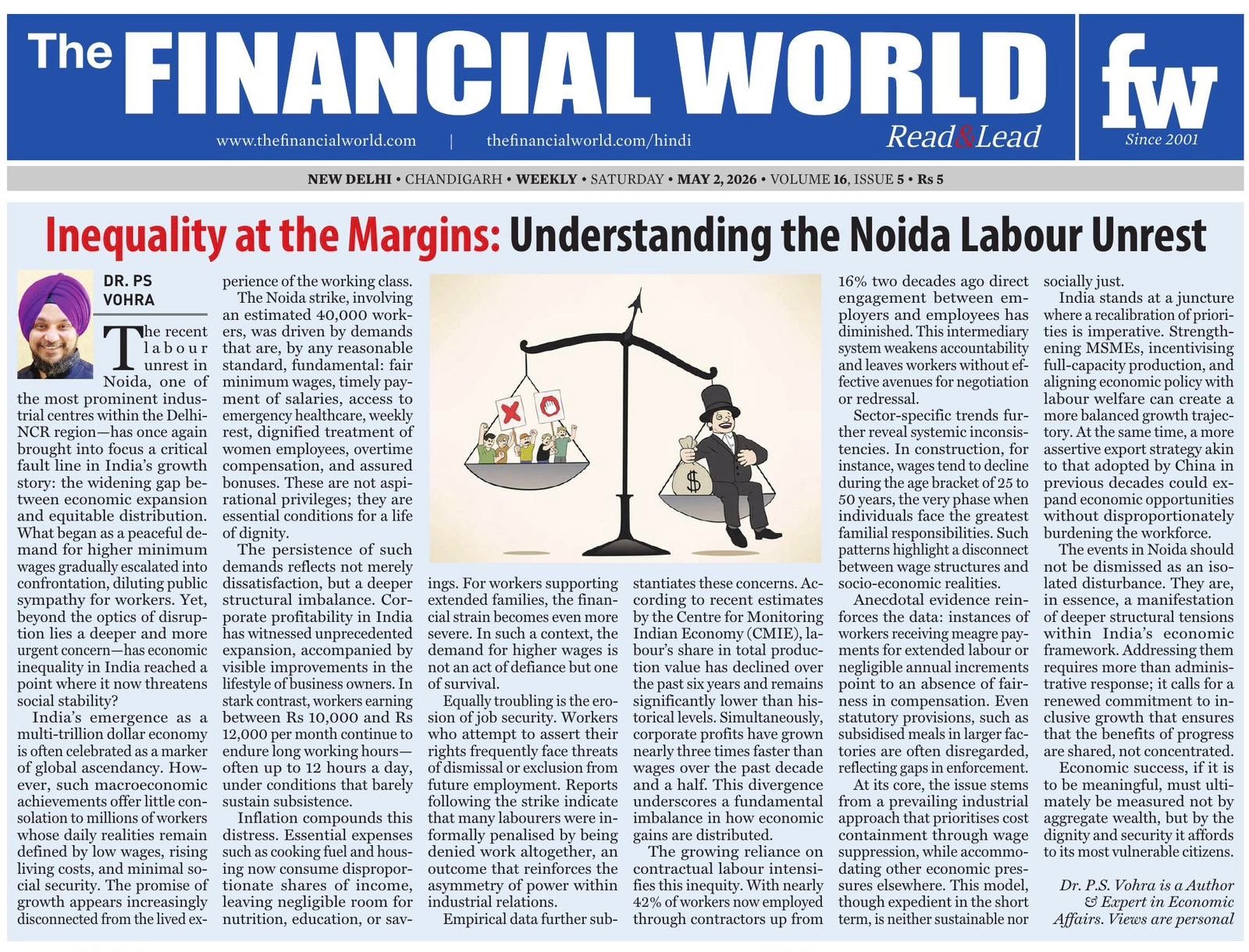
Empirical data further substantiates these concerns. According to recent estimates by the Centre for Monitoring Indian Economy (CMIE), labour's share in total production value has declined over the past six years and remains significantly lower than historical levels. Simultaneously, corporate profits have grown nearly three times faster than wages over the past decade and a half. This divergence underscores a fundamental imbalance in how economic gains are distributed.
The growing reliance on contractual labour intensifies this inequity. With nearly 42% of workers now employed through contractors up from 16% two decades ago direct engagement between employers and employees has diminished. This intermediary system weakens accountability and leaves workers without effective avenues for negotiation or redressal.
Sector-specific trends further reveal systemic inconsistencies. In construction, for instance, wages tend to decline during the age bracket of 25 to 50 years, the very phase when individuals face the greatest familial responsibilities. Such patterns highlight a disconnect between wage structures and socio-economic realities.
Anecdotal evidence reinforces the data: instances of workers receiving meagre payments for extended labour or negligible annual increments point to an absence of fairness in compensation. Even statutory provisions, such as subsidised meals in larger factories are often disregarded, reflecting gaps in enforcement.
At its core, the issue stems from a prevailing industrial approach that prioritises cost containment through wage suppression, while accommodating other economic pressures elsewhere. This model, though expedient in the short term, is neither sustainable nor socially just.
India stands at a juncture where a recalibration of priorities is imperative. Strengthening MSMEs, incentivising full-capacity production, and aligning economic policy with labour welfare can create a more balanced growth trajectory. At the same time, a more assertive export strategy akin to that adopted by China in previous decades could expand economic opportunities without disproportionately burdening the workforce.
The events in Noida should not be dismissed as an isolated disturbance. They are, in essence, a manifestation of deeper structural tensions within India's economic framework. Addressing them requires more than administrative response; it calls for a renewed commitment to inclusive growth that ensures that the benefits of progress are shared, not concentrated.
Economic success, if it is to be meaningful, must ultimately be measured not by aggregate wealth, but by the dignity and security it affords to its most vulnerable citizens.
*Dr. P.S. Vohra is a Author & Expert in Economic Affairs. Views are personal*