Global Trade deal Overshadows the Budget
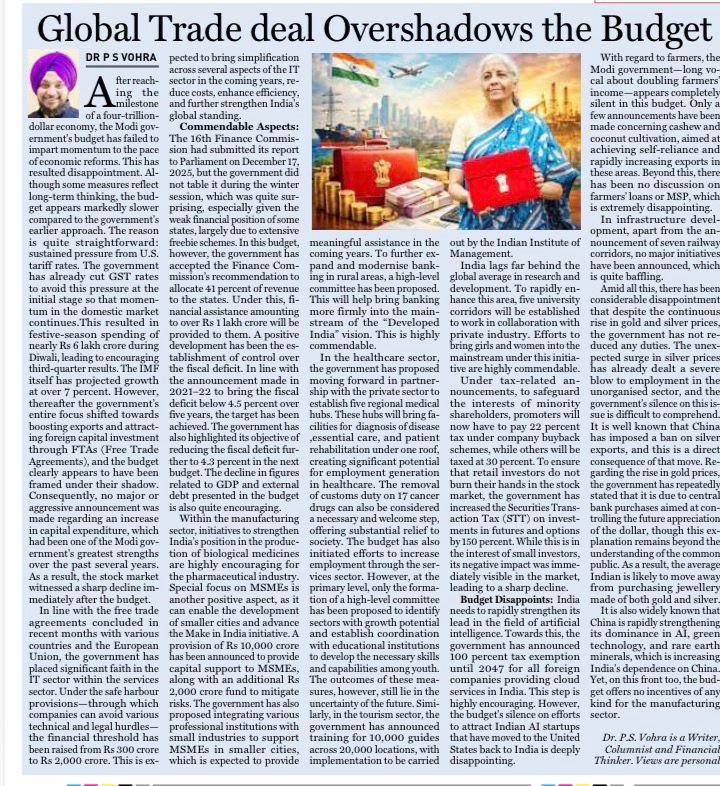
After reaching the milestone of a four-trillion-dollar economy, the Modi government's budget has failed to impart momentum to the pace of economic reforms. This has resulted disappointment. Although some measures reflect long-term thinking, the budget appears markedly slower compared to the government's earlier approach. The reason is quite straightforward: sustained pressure from U.S. tariff rates. The government has already cut GST rates to avoid this pressure at the initial stage so that momentum in the domestic market continues.This resulted in festive-season spending of nearly Rs 6 lakh crore during Diwali, leading to encouraging third-quarter results. The IMF itself has projected growth at over 7 percent. However, thereafter the government's entire focus shifted towards boosting exports and attracting foreign capital investment through FTAs (Free Trade Agreements), and the budget clearly appears to have been framed under their shadow. Consequently, no major or aggressive announcement was made regarding an increase in capital expenditure, which had been one of the Modi government's greatest strengths over the past several years. As a result, the stock market witnessed a sharp decline immediately after the budget.
In line with the free trade agreements concluded in recent months with various countries and the European Union, the government has placed significant faith in the IT sector within the services sector. Under the safe harbour provisions—through which companies can avoid various technical and legal hurdles—the financial threshold has been raised from Rs 300 crore to Rs 2,000 crore. This is expected to bring simplification across several aspects of the IT sector in the coming years, reduce costs, enhance efficiency, and further strengthen India's global standing.
Commendable Aspects: The 16th Finance Commission had submitted its report to Parliament on December 17, 2025, but the government did not table it during the winter session, which was quite surprising, especially given the weak financial position of some states, largely due to extensive freebie schemes. In this budget, however, the government has accepted the Finance Commission's recommendation to allocate 41 percent of revenue to the states. Under this, financial assistance amounting to over Rs 1 lakh crore will be provided to them. A positive development has been the establishment of control over the fiscal deficit. In line with the announcement made in 2021-22 to bring the fiscal deficit below 4.5 percent over five years, the target has been achieved. The government has also highlighted its objective of reducing the fiscal deficit further to 4.3 percent in the next budget. The decline in figures related to GDP and external debt presented in the budget is also quite encouraging.
Within the manufacturing sector, initiatives to strengthen India's position in the production of biological medicines are highly encouraging for the pharmaceutical industry. Special focus on MSMEs is another positive aspect, as it can enable the development of smaller cities and advance the Make in India initiative. A provision of Rs 10,000 crore has been announced to provide capital support to MSMEs, along with an additional Rs 2,000 crore fund to mitigate risks. The government has also proposed integrating various professional institutions with small industries to support MSMEs in smaller cities, which is expected to provide meaningful assistance in the coming years. To further expand and modernise banking in rural areas, a high-level committee has been proposed. This will help bring banking more firmly into the mainstream of the "Developed India" vision. This is highly commendable.
In the healthcare sector, the government has proposed moving forward in partnership with the private sector to establish five regional medical hubs. These hubs will bring facilities for diagnosis of disease ,essential care, and patient rehabilitation under one roof, creating significant potential for employment generation in healthcare. The removal of customs duty on 17 cancer drugs can also be considered a necessary and welcome step, offering substantial relief to society. The budget has also initiated efforts to increase employment through the services sector. However, at the primary level, only the formation of a high-level committee has been proposed to identify sectors with growth potential and establish coordination with educational institutions to develop the necessary skills and capabilities among youth. The outcomes of these measures, however, still lie in the uncertainty of the future. Similarly, in the tourism sector, the government has announced training for 10,000 guides across 20,000 locations, with implementation to be carried out by the Indian Institute of Management.
India lags far behind the global average in research and development. To rapidly enhance this area, five university corridors will be established to work in collaboration with private industry. Efforts to bring girls and women into the mainstream under this initiative are highly commendable.
Under tax-related announcements, to safeguard the interests of minority shareholders, promoters will now have to pay 22 percent tax under company buyback schemes, while others will be taxed at 30 percent. To ensure that retail investors do not burn their hands in the stock market, the government has increased the Securities Transaction Tax (STT) on investments in futures and options by 150 percent. While this is in the interest of small investors, its negative impact was immediately visible in the market, leading to a sharp decline.
Budget Disappoints: India needs to rapidly strengthen its lead in the field of artificial intelligence. Towards this, the government has announced 100 percent tax exemption until 2047 for all foreign companies providing cloud services in India. This step is highly encouraging. However, the budget's silence on efforts to attract Indian AI startups that have moved to the United States back to India is deeply disappointing.
With regard to farmers, the Modi government—long vocal about doubling farmers' income—appears completely silent in this budget. Only a few announcements have been made concerning cashew and coconut cultivation, aimed at achieving self-reliance and rapidly increasing exports in these areas. Beyond this, there has been no discussion on farmers' loans or MSP, which is extremely disappointing.
In infrastructure development, apart from the announcement of seven railway corridors, no major initiatives have been announced, which is quite baffling.
Amid all this, there has been considerable disappointment that despite the continuous rise in gold and silver prices, the government has not reduced any duties. The unexpected surge in silver prices has already dealt a severe blow to employment in the unorganised sector, and the government's silence on this issue is difficult to comprehend. It is well known that China has imposed a ban on silver exports, and this is a direct consequence of that move. Regarding the rise in gold prices, the government has repeatedly stated that it is due to central bank purchases aimed at controlling the future appreciation of the dollar, though this explanation remains beyond the understanding of the common public. As a result, the average Indian is likely to move away from purchasing jewellery made of both gold and silver.
It is also widely known that China is rapidly strengthening its dominance in AI, green technology, and rare earth minerals, which is increasing India's dependence on China. Yet, on this front too, the budget offers no incentives of any kind for the manufacturing sector.
*Dr. P.S. Vohra is a Writer, Columnist and Financial Thinker. Views are personal*