First India
INDIAN UPI IS NOW GLOBAL
Indian Unified Payments Interface (UPI) is receiving global appreciation on a vast scale. It's indeed a phenomenal accomplishment and sense of great feeling because when you look at the story of less than a decade of UPI, you find that our Country has given a new shape to the entire globe for digital payments. This has emerged as a game-changer in India's expedition for a digital future by enabling secure and inclusive financial transactions. This system has also transformed the way Indians conduct transactions, making millions financially empowered while driving Indian economic growth.
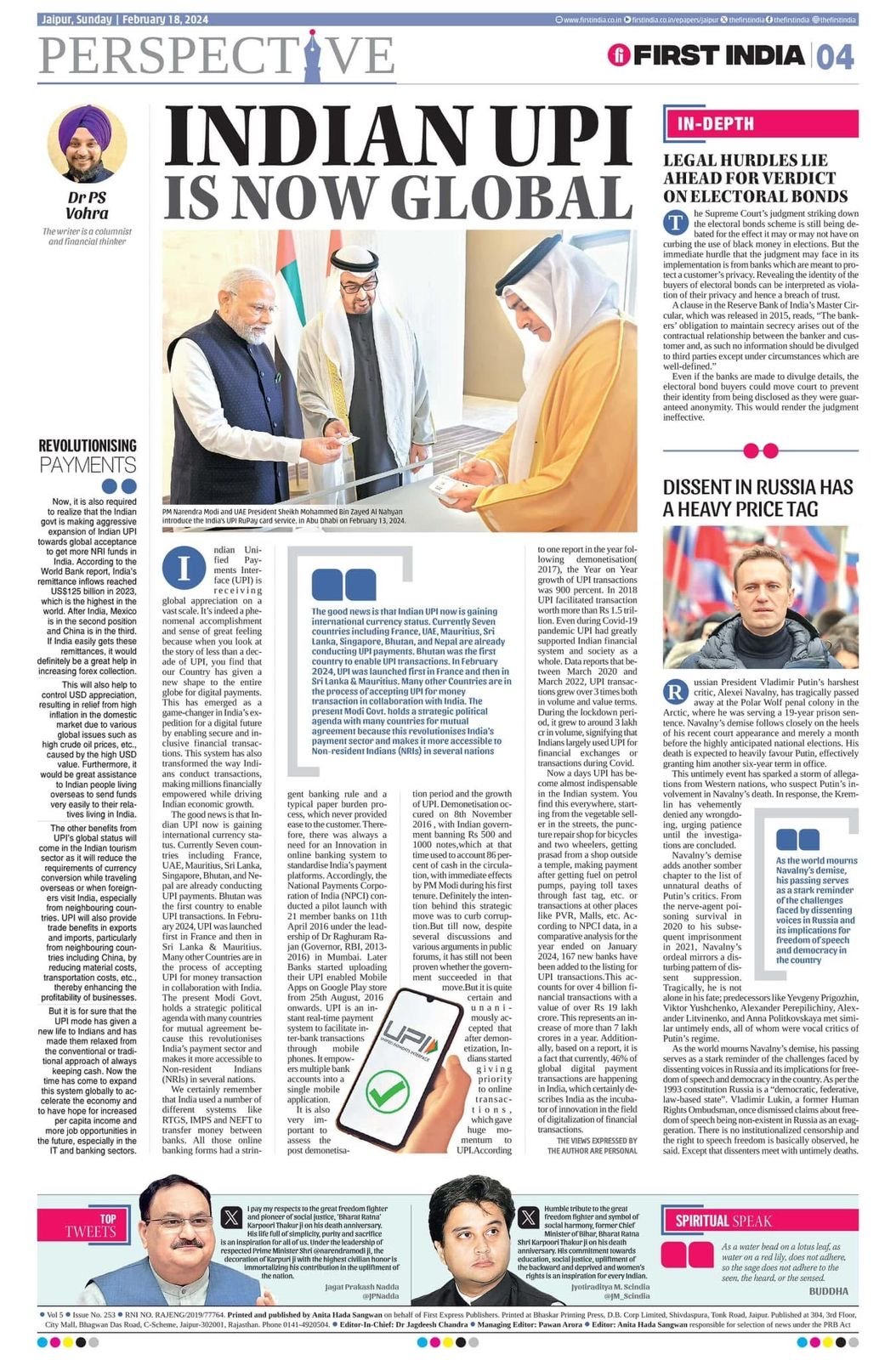
The good news is that Indian UPI now is gaining international currency status. Currently Seven countries including France, UAE, Mauritius, Sri Lanka, Singapore, Bhutan, and Nepal are already conducting UPI payments. Bhutan was the first country to enable UPI transactions. In February 2024, UPI was launched first in France and then in Sri Lanka & Mauritius. Many other Countries are in the process of accepting UPI for money transaction in collaboration with India. The present Modi Govt. holds a strategic political agenda with many countries for mutual agreement because this revolutionises India's payment sector and makes it more accessible to Non-resident Indians (NRIs) in several nations.
We certainly remember that India used a number of different systems like RTGS, IMPS and NEFT to transfer money between banks. All those online banking forms had a stringent banking rule and a typical paper burden process, which never provided ease to the customer. Therefore, there was always a need for an Innovation in online banking system to standardise India's payment platforms. Accordingly, the National Payments Corporation of India (NPCI) conducted a pilot launch with 21 member banks on 11th April 2016 under the leadership of Dr Raghuram Rajan (Governor, RBI, 2013-2016) in Mumbai. Later Banks started uploading their UPI enabled Mobile Apps on Google Play store from 25th August, 2016 onwards. UPI is an instant real-time payment system to facilitate inter-bank transactions through mobile phones. It empowers multiple bank accounts into a single mobile application.
It is also very important to assess the post demonetisation period and the growth of UPI. Demonetisation occured on 8th November 2016 , with Indian government banning Rs 500 and 1000 notes,which at that time used to account 86 percent of cash in the circulation, with immediate effects by PM Modi during his first tenure. Definitely the intention behind this strategic move was to curb corruption.But till now, despite several discussions and various arguments in public forums, it has still not been proven whether the government succeeded in that move.But it is quite certain and unanimously accepted that after demonetization, Indians started giving priority to online transactions, which gave huge momentum to UPI.According to one report in the year following demonetisation( 2017), the Year on Year growth of UPI transactions was 900 percent. In 2018 UPI facilitated transaction worth more than Rs 1.5 trillion. Even during Covid-19 pandemic UPI had greatly supported Indian financial system and society as a whole. Data reports that between March 2020 and March 2022, UPI transactions grew over 3 times both in volume and value terms. During the lockdown period, it grew to around 3 lakh cr in volume, signifying that Indians largely used UPI for financial exchanges or transactions during Covid.
Now a days UPI has become almost indispensable in the Indian system. You find this everywhere, starting from the vegetable seller in the streets, the puncture repair shop for bicycles and two wheelers, getting prasad from a shop outside a temple, making payment after getting fuel on petrol pumps, paying toll taxes through fast tag, etc. or transactions at other places like PVR, Malls, etc. According to NPCI data, in a comparative analysis for the year ended on January 2024, 167 new banks have been added to the listing for UPI transactions.This accounts for over 4 billion financial transactions with a value of over Rs 19 lakh crore. This represents an increase of more than 7 lakh crores in a year. Additionally, based on a report, it is a fact that currently, 46% of global digital payment transactions are happening in India, which certainly describes India as the incubator of innovation in the field of digitalization of financial transactions.
THE VIEWS EXPRESSED BY THE AUTHOR ARE PERSONAL
REVOLUTIONISING PAYMENTS
Now, it is also required to realize that the Indian govt is making aggressive expansion of Indian UPI towards global acceptance to get more NRI funds in India. According to the World Bank report, India's remittance inflows reached US$125 billion in 2023, which is the highest in the world. After India, Mexico is in the second position and China is in the third. If India easily gets these remittances, it would definitely be a great help in increasing forex collection.
This will also help to control USD appreciation, resulting in relief from high inflation in the domestic market due to various global issues such as high crude oil prices, etc., caused by the high USD value. Furthermore, it would be great assistance to Indian people living overseas to send funds very easily to their relatives living in India.
The other benefits from UPI's global status will come in the Indian tourism sector as it will reduce the requirements of currency conversion while traveling overseas or when foreigners visit India, especially from neighbouring countries. UPI will also provide trade benefits in exports and imports, particularly from neighbouring countries including China, by reducing material costs, transportation costs, etc., thereby enhancing the profitability of businesses.
But it is for sure that the UPI mode has given a new life to Indians and has made them relaxed from the conventional or traditional approach of always keeping cash. Now the time has come to expand this system globally to accelerate the economy and to have hope for increased per capita income and more job opportunities in the future, especially in the IT and banking sectors.