First India
FROM CRUDE TO GOLD THE ECONOMIC STORM BEHIND MODI’S SEVEN APPEALS
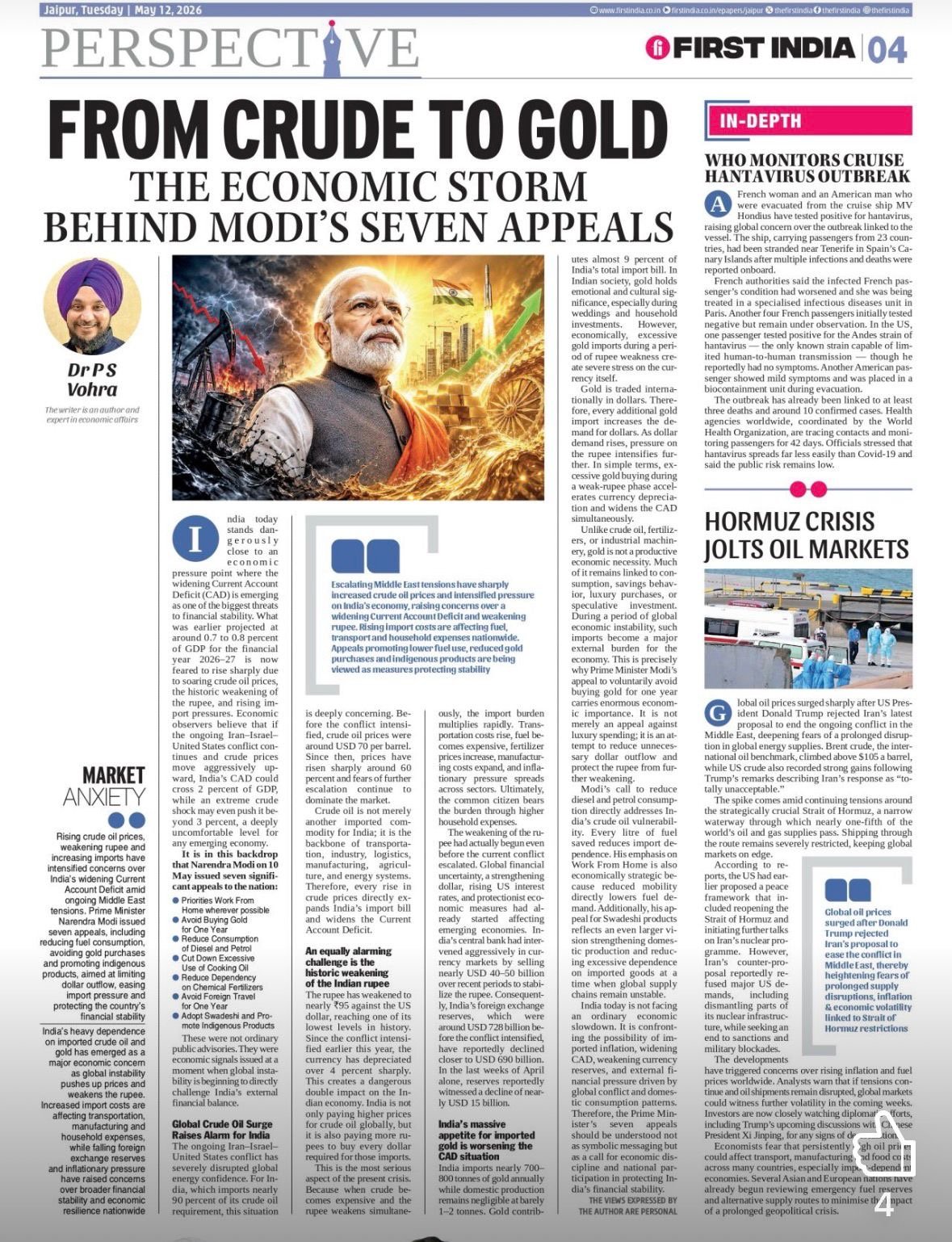
MARKET ANXIETY — Rising crude oil prices, weakening rupee and increasing imports have intensified concerns over India's widening Current Account Deficit amid ongoing Middle East tensions. Prime Minister Narendra Modi issued seven appeals, including reducing fuel consumption, avoiding gold purchases and promoting indigenous products, aimed at limiting dollar outflow, easing import pressure and protecting the country's financial stability
India today stands dangerously close to an economic pressure point where the widening Current Account Deficit (CAD) is emerging as one of the biggest threats to financial stability. What was earlier projected at around 0.7 to 0.8 percent of GDP for the financial year 2026–27 is now feared to rise sharply due to soaring crude oil prices, the historic weakening of the rupee, and rising import pressures. Economic observers believe that if the ongoing Iran–Israel–United States conflict continues and crude prices move aggressively upward, India's CAD could cross 2 percent of GDP, while an extreme crude shock may even push it beyond 3 percent, a deeply uncomfortable level for any emerging economy.
It is in this backdrop that Narendra Modi on 10 May issued seven significant appeals to the nation:
– Priorities Work From Home wherever possible – Avoid Buying Gold for One Year – Reduce Consumption of Diesel and Petrol – Cut Down Excessive Use of Cooking Oil – Reduce Dependency on Chemical Fertilizers – Avoid Foreign Travel for One Year – Adopt Swadeshi and Promote Indigenous Products
These were not ordinary public advisories. They were economic signals issued at a moment when global instability is beginning to directly challenge India's external financial balance.
Global Crude Oil Surge Raises Alarm for India
The ongoing Iran–Israel–United States conflict has severely disrupted global energy confidence. For India, which imports nearly 90 percent of its crude oil requirement, this situation is deeply concerning. Before the conflict intensified, crude oil prices were around USD 70 per barrel. Since then, prices have risen sharply around 60 percent and fears of further escalation continue to dominate the market.
Crude oil is not merely another imported commodity for India; it is the backbone of transportation, industry, logistics, manufacturing, agriculture, and energy systems. Therefore, every rise in crude prices directly expands India's import bill and widens the Current Account Deficit.
An equally alarming challenge is the historic weakening of the Indian rupee
The rupee has weakened to nearly ₹95 against the US dollar, reaching one of its lowest levels in history. Since the conflict intensified earlier this year, the currency has depreciated over 4 percent sharply. This creates a dangerous double impact on the Indian economy. India is not only paying higher prices for crude oil globally, but it is also paying more rupees to buy every dollar required for those imports.
This is the most serious aspect of the present crisis. Because when crude becomes expensive and the rupee weakens simultaneously, the import burden multiplies rapidly. Transportation costs rise, fuel becomes expensive, fertilizer prices increase, manufacturing costs expand, and inflationary pressure spreads across sectors. Ultimately, the common citizen bears the burden through higher household expenses.
The weakening of the rupee had actually begun even before the current conflict escalated. Global financial uncertainty, a strengthening dollar, rising US interest rates, and protectionist economic measures had already started affecting emerging economies. India's central bank had intervened aggressively in currency markets by selling nearly USD 40–50 billion over recent periods to stabilize the rupee. Consequently, India's foreign exchange reserves, which were around USD 728 billion before the conflict intensified, have reportedly declined closer to USD 690 billion. In the last weeks of April alone, reserves reportedly witnessed a decline of nearly USD 15 billion.
India's massive appetite for imported gold is worsening the CAD situation
India imports nearly 700–800 tonnes of gold annually while domestic production remains negligible at barely 1–2 tonnes. Gold contributes almost 9 percent of India's total import bill. In Indian society, gold holds emotional and cultural significance, especially during weddings and household investments. However, economically, excessive gold imports during a period of rupee weakness create severe stress on the currency itself.
Gold is traded internationally in dollars. Therefore, every additional gold import increases the demand for dollars. As dollar demand rises, pressure on the rupee intensifies further. In simple terms, excessive gold buying during a weak-rupee phase accelerates currency depreciation and widens the CAD simultaneously.
Unlike crude oil, fertilizers, or industrial machinery, gold is not a productive economic necessity. Much of it remains linked to consumption, savings behavior, luxury purchases, or speculative investment. During a period of global economic instability, such imports become a major external burden for the economy. This is precisely why Prime Minister Modi's appeal to voluntarily avoid buying gold for one year carries enormous economic importance. It is not merely an appeal against luxury spending; it is an attempt to reduce unnecessary dollar outflow and protect the rupee from further weakening.
Modi's call to reduce diesel and petrol consumption directly addresses India's crude oil vulnerability. Every litre of fuel saved reduces import dependence. His emphasis on Work From Home is also economically strategic because reduced mobility directly lowers fuel demand. Additionally, his appeal for Swadeshi products reflects an even larger vision strengthening domestic production and reducing excessive dependence on imported goods at a time when global supply chains remain unstable.
India today is not facing an ordinary economic slowdown. It is confronting the possibility of imported inflation, widening CAD, weakening currency reserves, and external financial pressure driven by global conflict and domestic consumption patterns. Therefore, the Prime Minister's seven appeals should be understood not as symbolic messaging but as a call for economic discipline and national participation in protecting India's financial stability.
THE VIEWS EXPRESSED BY THE AUTHOR ARE PERSONAL