INCREASE IN TAX EXEMPTION: A MASTERSTROKE!
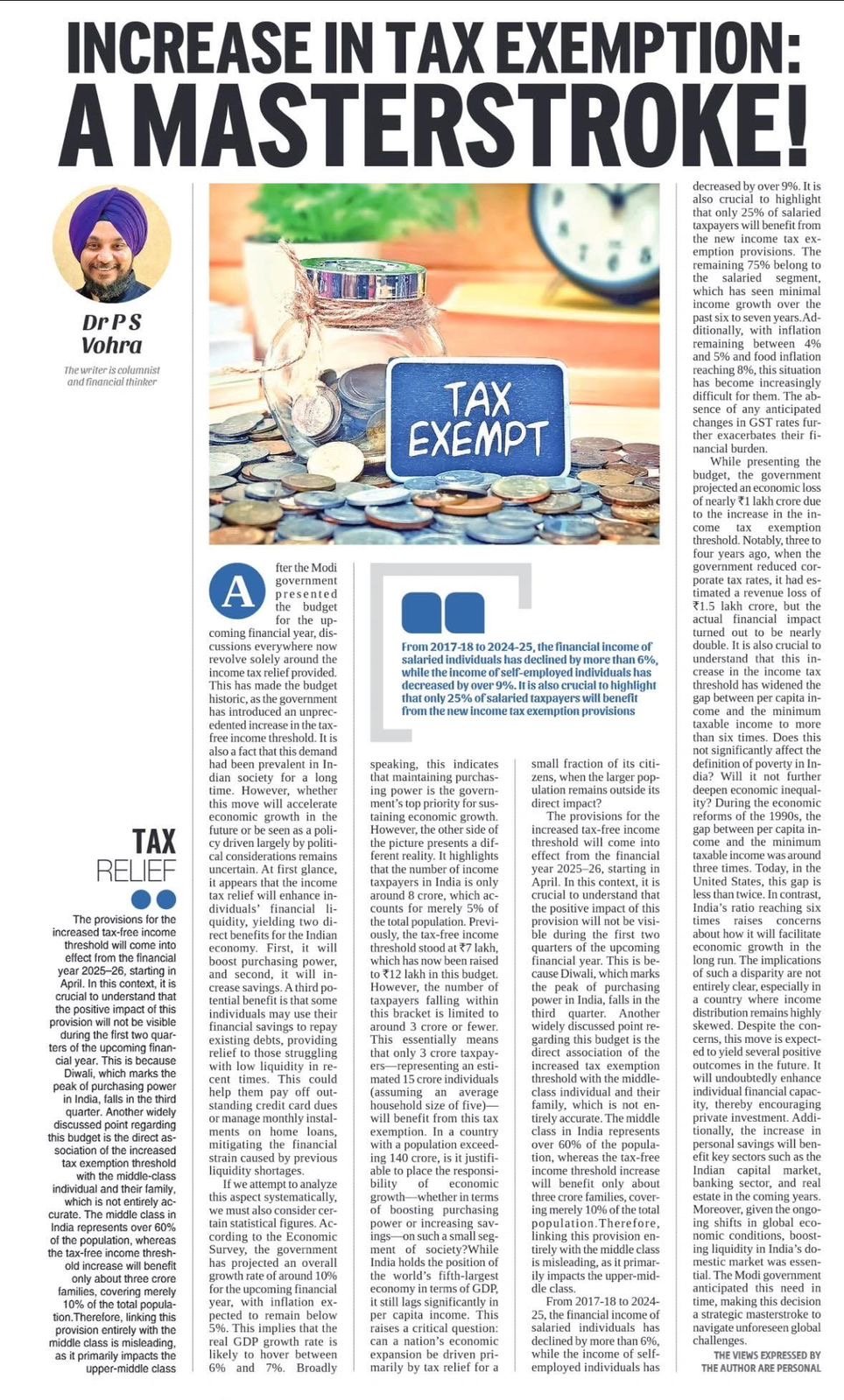
After the Modi government presented the budget for the upcoming financial year, discussions everywhere now revolve solely around the income tax relief provided. This has made the budget historic, as the government has introduced an unprecedented increase in the tax-free income threshold. It is also a fact that this demand had been prevalent in Indian society for a long time. However, whether this move will accelerate economic growth in the future or be seen as a policy driven largely by political considerations remains uncertain. At first glance, it appears that the income tax relief will enhance individuals' financial liquidity, yielding two direct benefits for the Indian economy. First, it will boost purchasing power, and second, it will increase savings. A third potential benefit is that some individuals may use their financial savings to repay existing debts, providing relief to those struggling with low liquidity in recent times. This could help them pay off outstanding credit card dues or manage monthly instalments on home loans, mitigating the financial strain caused by previous liquidity shortages.
If we attempt to analyze this aspect systematically, we must also consider certain statistical figures. According to the Economic Survey, the government has projected an overall growth rate of around 10% for the upcoming financial year, with inflation expected to remain below 5%. This implies that the real GDP growth rate is likely to hover between 6% and 7%. Broadly speaking, this indicates that maintaining purchasing power is the government's top priority for sustaining economic growth. However, the other side of the picture presents a different reality. It highlights that the number of income taxpayers in India is only around 8 crore, which accounts for merely 5% of the total population. Previously, the tax-free income threshold stood at ₹7 lakh, which has now been raised to ₹12 lakh in this budget. However, the number of taxpayers falling within this bracket is limited to around 3 crore or fewer. This essentially means that only 3 crore taxpayers—representing an estimated 15 crore individuals (assuming an average household size of five)—will benefit from this tax exemption. In a country with a population exceeding 140 crore, is it justifiable to place the responsibility of economic growth—whether in terms of boosting purchasing power or increasing savings—on such a small segment of society? While India holds the position of the world's fifth-largest economy in terms of GDP, it still lags significantly in per capita income. This raises a critical question: can a nation's economic expansion be driven primarily by tax relief for a small fraction of its citizens, when the larger population remains outside its direct impact?
The provisions for the increased tax-free income threshold will come into effect from the financial year 2025–26, starting in April. In this context, it is crucial to understand that the positive impact of this provision will not be visible during the first two quarters of the upcoming financial year. This is because Diwali, which marks the peak of purchasing power in India, falls in the third quarter. Another widely discussed point regarding this budget is the direct association of the increased tax exemption threshold with the middle-class individual and their family, which is not entirely accurate. The middle class in India represents over 60% of the population, whereas the tax-free income threshold increase will benefit only about three crore families, covering merely 10% of the total population. Therefore, linking this provision entirely with the middle class is misleading, as it primarily impacts the upper-middle class.
From 2017-18 to 2024-25, the financial income of salaried individuals has declined by more than 6%, while the income of self-employed individuals has decreased by over 9%. It is also crucial to highlight that only 25% of salaried taxpayers will benefit from the new income tax exemption provisions. The remaining 75% belong to the salaried segment, which has seen minimal income growth over the past six to seven years. Additionally, with inflation remaining between 4% and 5% and food inflation reaching 8%, this situation has become increasingly difficult for them. The absence of any anticipated changes in GST rates further exacerbates their financial burden.
While presenting the budget, the government projected an economic loss of nearly ₹1 lakh crore due to the increase in the income tax exemption threshold. Notably, three to four years ago, when the government reduced corporate tax rates, it had estimated a revenue loss of ₹1.5 lakh crore, but the actual financial impact turned out to be nearly double. It is also crucial to understand that this increase in the income tax threshold has widened the gap between per capita income and the minimum taxable income to more than six times. Does this not significantly affect the definition of poverty in India? Will it not further deepen economic inequality? During the economic reforms of the 1990s, the gap between per capita income and the minimum taxable income was around three times. Today, in the United States, this gap is less than twice. In contrast, India's ratio reaching six times raises concerns about how it will facilitate economic growth in the long run. The implications of such a disparity are not entirely clear, especially in a country where income distribution remains highly skewed. Despite the concerns, this move is expected to yield several positive outcomes in the future. It will undoubtedly enhance individual financial capacity, thereby encouraging private investment. Additionally, the increase in personal savings will benefit key sectors such as the Indian capital market, banking sector, and real estate in the coming years. Moreover, given the ongoing shifts in global economic conditions, boosting liquidity in India's domestic market was essential. The Modi government anticipated this need in time, making this decision a strategic masterstroke to navigate unforeseen global challenges.
THE VIEWS EXPRESSED BY THE AUTHOR ARE PERSONAL
—
Pull quote as printed:
> From 2017-18 to 2024-25, the financial income of salaried individuals has declined by more than 6%, while the income of self-employed individuals has decreased by over 9%. It is also crucial to highlight that only 25% of salaried taxpayers will benefit from the new income tax exemption provisions
Left sidebar box as printed:
TAX RELIEF
> The provisions for the increased tax-free income threshold will come into effect from the financial year 2025–26, starting in April. In this context, it is crucial to understand that the positive impact of this provision will not be visible during the first two quarters of the upcoming financial year. This is because Diwali, which marks the peak of purchasing power in India, falls in the third quarter. Another widely discussed point regarding this budget is the direct association of the increased tax exemption threshold with the middle-class individual and their family, which is not entirely accurate. The middle class in India represents over 60% of the population, whereas the tax-free income threshold increase will benefit only about three crore families, covering merely 10% of the total population. Therefore, linking this provision entirely with the middle class is misleading, as it primarily impacts the upper-middle class