First India
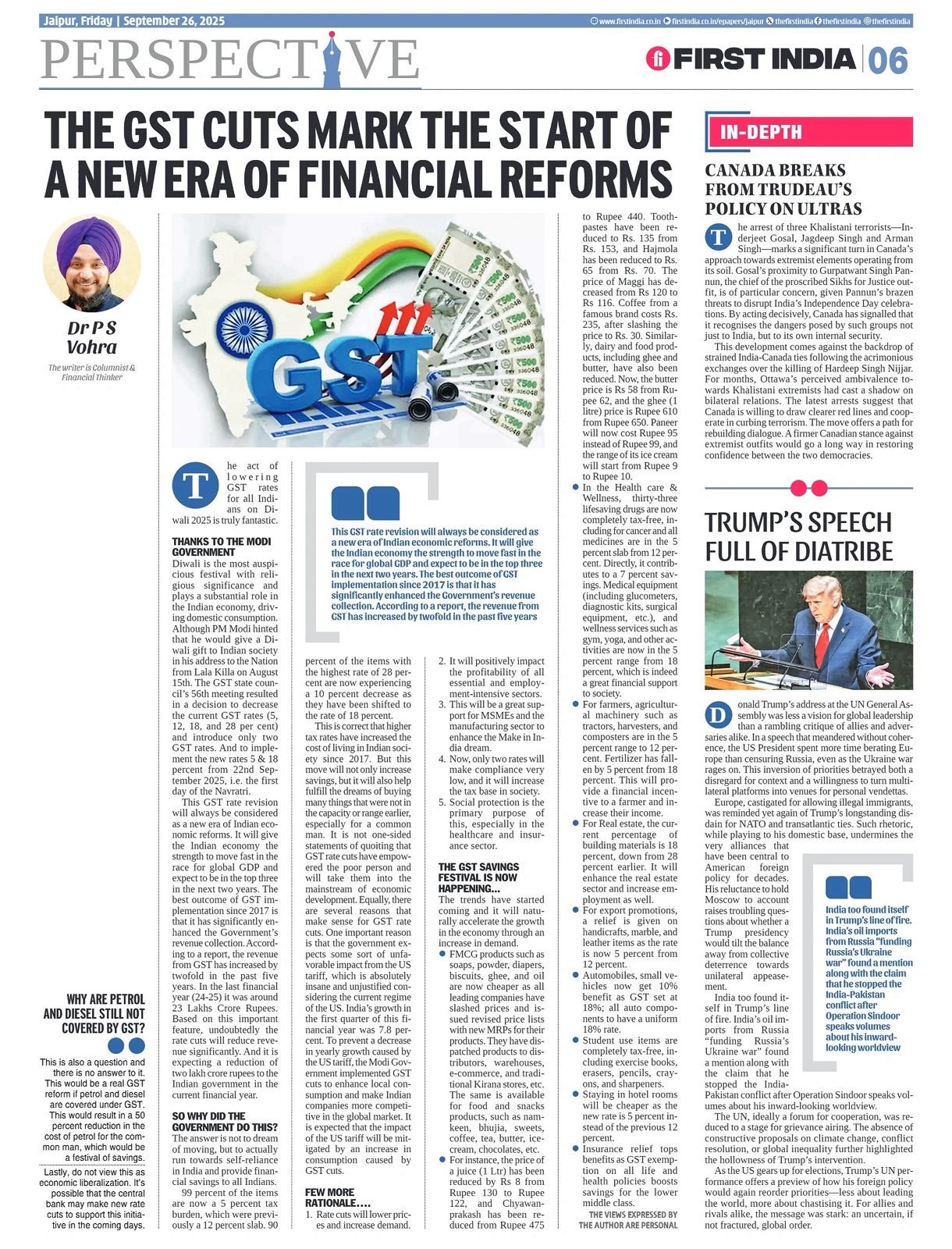
THE GST CUTS MARK THE START OF A NEW ERA OF FINANCIAL REFORMS
The act of lowering GST rates for all Indians on Diwali 2025 is truly fantastic.
THANKS TO THE MODI GOVERNMENT
Diwali is the most auspicious festival with religious significance and plays a substantial role in the Indian economy, driving domestic consumption. Although PM Modi hinted that he would give a Diwali gift to Indian society in his address to the Nation from Lala Killa on August 15th. The GST state council's 56th meeting resulted in a decision to decrease the current GST rates (5, 12, 18, and 28 per cent) and introduce only two GST rates. And to implement the new rates 5 & 18 percent from 22nd September 2025, i.e. the first day of the Navratri.
This GST rate revision will always be considered as a new era of Indian economic reforms. It will give the Indian economy the strength to move fast in the race for global GDP and expect to be in the top three in the next two years. The best outcome of GST implementation since 2017 is that it has significantly enhanced the Government's revenue collection. According to a report, the revenue from GST has increased by twofold in the past five years. In the last financial year (24-25) it was around 23 Lakhs Crore Rupees. Based on this important feature, undoubtedly the rate cuts will reduce revenue significantly. And it is expecting a reduction of two lakh crore rupees to the Indian government in the current financial year.
SO WHY DID THE GOVERNMENT DO THIS?
The answer is not to dream of moving, but to actually run towards self-reliance in India and provide financial savings to all Indians.
99 percent of the items are now a 5 percent tax burden, which were previously a 12 percent slab. 90 percent of the items with the highest rate of 28 percent are now experiencing a 10 percent decrease as they have been shifted to the rate of 18 percent.
This is correct that higher tax rates have increased the cost of living in Indian society since 2017. But this move will not only increase savings, but it will also help fulfill the dreams of buying many things that were not in the capacity or range earlier, especially for a common man. It is not one-sided statements of quoiting that GST rate cuts have empowered the poor person and will take them into the mainstream of economic development. Equally, there are several reasons that make sense for GST rate cuts. One important reason is that the government expects some sort of unfavorable impact from the US tariff, which is absolutely insane and unjustified considering the current regime of the US. India's growth in the first quarter of this financial year was 7.8 percent. To prevent a decrease in yearly growth caused by the US tariff, the Modi Government implemented GST cuts to enhance local consumption and make Indian companies more competitive in the global market. It is expected that the impact of the US tariff will be mitigated by an increase in consumption caused by GST cuts.
FEW MORE RATIONALE….
1. Rate cuts will lower prices and increase demand. 2. It will positively impact the profitability of all essential and employment-intensive sectors. 3. This will be a great support for MSMEs and the manufacturing sector to enhance the Make in India dream. 4. Now, only two rates will make compliance very low, and it will increase the tax base in society. 5. Social protection is the primary purpose of this, especially in the healthcare and insurance sector.
THE GST SAVINGS FESTIVAL IS NOW HAPPENING…
The trends have started coming and it will naturally accelerate the growth in the economy through an increase in demand.
– FMCG products such as soaps, powder, diapers, biscuits, ghee, and oil are now cheaper as all leading companies have slashed prices and issued revised price lists with new MRPs for their products. They have dispatched products to distributors, warehouses, e-commerce, and traditional Kirana stores, etc. The same is available for food and snacks products, such as namkeen, bhujia, sweets, coffee, tea, butter, ice-cream, chocolates, etc. – For instance, the price of a juice (1 Ltr) has been reduced by Rs 8 from Rupee 130 to Rupee 122, and Chyawanprakash has been reduced from Rupee 475 to Rupee 440. Toothpastes have been reduced to Rs. 135 from Rs. 153, and Hajmola has been reduced to Rs. 65 from Rs. 70. The price of Maggi has decreased from Rs 120 to Rs 116. Coffee from a famous brand costs Rs. 235, after slashing the price to Rs. 30. Similarly, dairy and food products, including ghee and butter, have also been reduced. Now, the butter price is Rs 58 from Rupee 62, and the ghee (1 litre) price is Rupee 610 from Rupee 650. Paneer will now cost Rupee 95 instead of Rupee 99, and the range of its ice cream will start from Rupee 9 to Rupee 10. – In the Health care & Wellness, thirty-three lifesaving drugs are now completely tax-free, including for cancer and all medicines are in the 5 percent slab from 12 percent. Directly, it contributes to a 7 percent savings. Medical equipment (including glucometers, diagnostic kits, surgical equipment, etc.), and wellness services such as gym, yoga, and other activities are now in the 5 percent range from 18 percent, which is indeed a great financial support to society. – For farmers, agricultural machinery such as tractors, harvesters, and composters are in the 5 percent range to 12 percent. Fertilizer has fallen by 5 percent from 18 percent. This will provide a financial incentive to a farmer and increase their income. – For Real estate, the current percentage of building materials is 18 percent, down from 28 percent earlier. It will enhance the real estate sector and increase employment as well. – For export promotions, a relief is given on handicrafts, marble, and leather items as the rate is now 5 percent from 12 percent. – Automobiles, small vehicles now get 10% benefit as GST set at 18%; all auto components to have a uniform 18% rate. – Student use items are completely tax-free, including exercise books, erasers, pencils, crayons, and sharpeners. – Staying in hotel rooms will be cheaper as the new rate is 5 percent instead of the previous 12 percent. – Insurance relief tops benefits as GST exemption on all life and health policies boosts savings for the lower middle class.
THE VIEWS EXPRESSED BY THE AUTHOR ARE PERSONAL
WHY ARE PETROL AND DIESEL STILL NOT COVERED BY GST?
This is also a question and there is no answer to it. This would be a real GST reform if petrol and diesel are covered under GST. This would result in a 50 percent reduction in the cost of petrol for the common man, which would be a festival of savings.
Lastly, do not view this as economic liberalization. It's possible that the central bank may make new rate cuts to support this initiative in the coming days.
> This GST rate revision will always be considered as a new era of Indian economic reforms. It will give the Indian economy the strength to move fast in the race for global GDP and expect to be in the top three in the next two years. The best outcome of GST implementation since 2017 is that it has significantly enhanced the Government's revenue collection. According to a report, the revenue from GST has increased by twofold in the past five years